








When it comes to timekeeping, many countries around the world use a 24-hour format, also known as military time. This system eliminates any confusion between AM and PM, making it especially useful in contexts like military operations, transportation schedules, and various international settings. If you’ve ever been unsure about how to convert standard time to military time, a military time chart can be an invaluable resource. In this article, we will explore the military time system in depth, provide a detailed military time chart, and offer helpful tips on how to read and convert military time accurately.
What Is Military Time?
Military time, also known as the 24-hour clock, is a time format that divides the day into 24 hours, beginning at midnight (00:00) and running through to 23:59. This system is used extensively in military settings, aviation, healthcare, and various international contexts because it removes any ambiguity that can arise when using the 12-hour clock, which requires the use of “AM” and “PM” to distinguish between morning and evening hours.
Key Features of Military Time
- No AM or PM: In military time, there is no need to differentiate between AM and PM. The time is expressed as a four-digit number, where the first two digits represent the hour, and the last two digits represent the minutes.
- 24-Hour Format: The hours range from 00 (midnight) to 23, covering all 24 hours of the day. This eliminates any confusion about whether a time is in the morning or afternoon.
- Military Time Chart: A military time chart can help you quickly reference the 24-hour system and convert military time to standard time or vice versa.
Why Is Military Time Used?
The primary reason for using military time is to avoid confusion between AM and PM times. This system is particularly useful in environments where precision and clarity are crucial, such as the military, air traffic control, and medical fields. Let’s explore some of the key uses of military time.
1. Military and Defense
In the military, clear and unambiguous communication is essential, especially when coordinating operations across different time zones. Military time ensures that there is no confusion when scheduling missions or communicating orders, whether it’s 2:00 AM or 2:00 PM. Using a military time chart helps personnel quickly interpret and convert times to ensure operations run smoothly.
2. International Travel and Transport
Airlines, railways, and other forms of transportation often use military time to avoid confusion in timetables. Since transportation services operate across different countries and time zones, using a military time chart makes it easier to standardize schedules and avoid errors.
3. Healthcare and Medical Services
In healthcare, especially in hospitals, military time helps doctors, nurses, and medical staff communicate more clearly. Since patients’ conditions can change rapidly, precise timekeeping is crucial for tracking medication schedules, surgeries, and emergency care. A military time chart ensures all staff are on the same page when it comes to timing.
4. Other Fields Requiring Precision
In fields such as engineering, scientific research, and computing, using military time helps eliminate confusion and ensures accurate time tracking. Whether coordinating a project or logging data, a military time chart provides a uniform standard for everyone involved.
How to Read Military Time
Understanding military time might seem complex at first, but with the help of a military time chart, it becomes easier to interpret. The key difference between military time and the 12-hour clock system is that military time uses a 24-hour format, with hours ranging from 00:00 (midnight) to 23:59 (one minute before the next midnight).
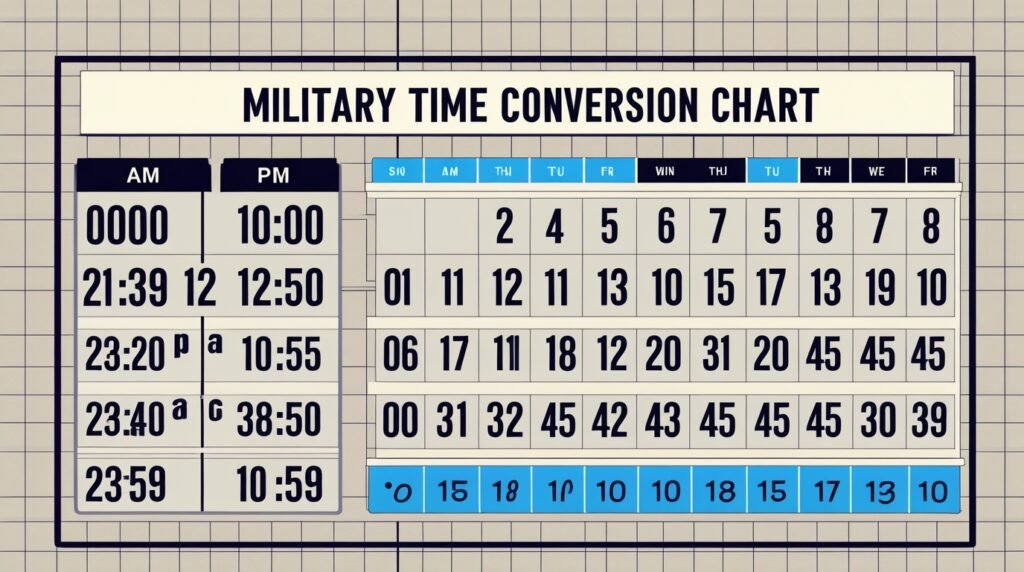
Military Time Chart Breakdown
| Standard Time | Military Time |
|---|---|
| 12:00 AM (Midnight) | 00:00 |
| 1:00 AM | 01:00 |
| 2:00 AM | 02:00 |
| 3:00 AM | 03:00 |
| 4:00 AM | 04:00 |
| 5:00 AM | 05:00 |
| 6:00 AM | 06:00 |
| 7:00 AM | 07:00 |
| 8:00 AM | 08:00 |
| 9:00 AM | 09:00 |
| 10:00 AM | 10:00 |
| 11:00 AM | 11:00 |
| 12:00 PM (Noon) | 12:00 |
| 1:00 PM | 13:00 |
| 2:00 PM | 14:00 |
| 3:00 PM | 15:00 |
| 4:00 PM | 16:00 |
| 5:00 PM | 17:00 |
| 6:00 PM | 18:00 |
| 7:00 PM | 19:00 |
| 8:00 PM | 20:00 |
| 9:00 PM | 21:00 |
| 10:00 PM | 22:00 |
| 11:00 PM | 23:00 |
In military time, you can see that the hours continue from 12 PM (noon) and increase by one hour for each subsequent hour in the afternoon and evening. To convert from standard time to military time:
- AM times remain largely unchanged from 12:00 AM to 11:59 AM. For example, 8:00 AM is 08:00 in military time.
- PM times start at 12:00 PM as 12:00 and continue from there, increasing by one hour. For example, 1:00 PM becomes 13:00, 2:00 PM becomes 14:00, and so on.
Example Conversion from Standard Time to Military Time
If you are trying to convert 3:30 PM into military time, simply add 12 hours to the standard time (since it’s in the PM):
- 3:30 PM = 15:30 military time.
On the other hand, converting 9:15 AM is straightforward since it’s already in the AM:
- 9:15 AM = 09:15 military time.
Why Should You Learn Military Time?
While military time is widely used in specific industries, it’s a useful system for anyone to learn. Here’s why:
1. Clarity and Precision
With no need for AM or PM distinctions, military time offers a clear, straightforward way to keep track of time. This is especially important in fields like medicine, aviation, and the military, where time-sensitive actions can make a difference between life and death.
2. Global Standardization
Since military time is used internationally, learning it ensures that you can understand schedules, timetables, and communications no matter where you are in the world. This is particularly helpful when traveling to countries where military time is the norm.
3. Simple Conversion
Once you are familiar with how to read a military time chart, converting between standard time and military time is easy. The process is simple, and with a little practice, you can read and convert military time with ease.
4. Reduces Errors
Using military time reduces the chances of scheduling mistakes. In the 12-hour system, 8:00 AM and 8:00 PM are two completely different times, but military time ensures there is no ambiguity.
How to Use a Military Time Chart for Conversions
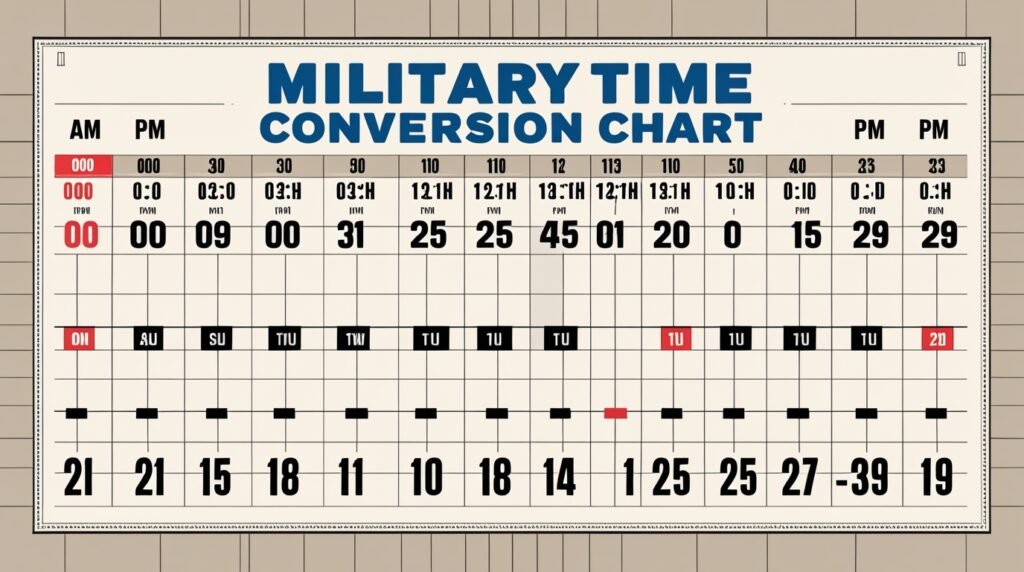
A military time chart is a simple, effective tool for anyone learning or working with the 24-hour system. It helps you convert standard time into military time and vice versa quickly. If you’re trying to get used to reading military time, it’s important to practice converting different times throughout the day to become familiar with the system.
Step-by-Step Guide to Using a Military Time Chart
- Identify the Hour: Start with the hour you need to convert.
- Check AM or PM: If it’s AM, the time will remain the same until 12 PM.
- Convert PM Times: For PM times, add 12 to the hour. For example, 2:00 PM becomes 14:00.
- Use a Chart: A military time chart will be your best friend as you convert. You can either memorize the chart or keep it handy for quick reference.
Frequently Asked Questions (FAQs)
1. How do you convert military time back to standard time?
To convert military time back to standard time, subtract 12 hours from any time after 12:00 (noon). For example, 16:00 in military time is 4:00 PM in standard time. If the military time is 12:00 or less, it’s the same as the standard time.
2. Why is military time used instead of the 12-hour format?
Military time is used to avoid confusion between AM and PM. It is more precise, particularly in fields where clear and unambiguous communication is critical, such as the military, aviation, and healthcare.
3. What’s the easiest way to learn military time?
Use a military time chart to familiarize yourself with the conversions and try converting various times throughout the day. Over time, you’ll get comfortable reading and converting military time without needing to refer to a chart.
Conclusion: Mastering Military Time for Accuracy and Precision
Learning how to read and convert military time is a valuable skill that can be applied in various fields and everyday life. With the help of a military time chart, understanding the 24-hour time system becomes straightforward and intuitive. Whether you’re in the military, traveling, or working in healthcare, military time ensures clarity and precision. By familiarizing yourself with this system, you can eliminate confusion and ensure that time-sensitive tasks are performed correctly. So, take a few minutes to practice with a military time chart and start reading military time like a pro today!